
'/%3E%3Cpath%20fill='%23b2b2b2'%20d='M241%20382q0%2016%2017%2026%2017%2011%2042%2011t42-11q16-11%2017-26V269H241'/%3E%3Cpath%20fill='%239f7e00'%20d='M241%20379q0%2014%208%2023%209%209%2021%209%2014%200%2021-9%209-9%209-23V269h-59'/%3E%3Cpath%20d='M241%20339v-70h59v110q0%2014-9%2023l-6%205v-68h-15v72q-8%200-14-4v-68zm59%2040c0%2022%2015%2032%2029%2032%2021%200%2030-18%2030-32v-40h-59'/%3E%3Cpath%20fill='%239f7e00'%20d='M266%20277v5h2v12h-3v-5h2v-5h-9v5h2v5h-4v9h3v18h-5v10h34v-10h-5v-18h3v-9h-4v-5h2v-5h-9v5h2v5h-3v-12h2v-5zm42%20101q0%2010%206%2017%206%206%2015%207%2010-1%2016-7%206-7%206-17v-29h-43'/%3E%3Ccircle%20fill='%230044ad'%20cx='329.5'%20cy='372'%20r='6'/%3E%3Cellipse%20fill='%230044ad'%20cx='300'%20cy='340'%20rx='16'%20ry='21'/%3E%3C/svg%3E)
'/%3E%3C/svg%3E)
Summary
How to keep your horse warm in winter from the inside, choosing the right forage and meals.
Our equine partners in northern climes may well have a little more time off than usual, depending on whether we have indoor arenas to train them or not.
However, whether your horse enjoys a winter holiday or not, he definitely requires the calories needed to keep him warm. You could be forgiven for thinking, oh, he’s working less, so he needs less, but the contrary is true.
Hay: The main fuel
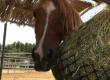
You could easily cut down on the grains, or hard feed, in light of reduced exercise. But never on forage. Remember, a horse’s diet should be composed mainly of hay, covering 1.5 – 2 per cent of its bodyweight. You could go up to 3 per cent, where most horses should feel full, and more would be counterproductive.
Equines use hay in particular to generate that heating energy. This is because hay moves slowly through the equine’s digestive system. Depending on the type fo fibre it can take up to 72 hours to come out at the other end.
Simplified, it starts with your horse wetting and chewing it down to send it to the stomach, where acid quickly breaks the fibre down to get to the nutritive parts. The small intestine takes over and extracts nutritious proteins, sugar, vitamins and minerals for the body to use.
Now to the important heating section, the hind gut, where hay can rest for well over 30 hours. Here, microbes, yes, those little beneficial critters, nibble on the fibre, fermenting the hay. Fermentation = VFA´s (volatile fatty acids) = Heat.
Voila, the heating is turned on!
Now it makes sense why making sure our equines have enough to nibble on for most part of the day and night ensures your equine partner does not lose weight over the winter.
Alfalfa offers more heat?
Alfalfa (Lucerne) makes for a nice body-building forage all year round. The reason is that it is higher in protein than grass, cereal, or hay. The higher protein content also creates more heating energy, which is less ideal in summer, but great for winter.
Personally, I would never feed alfalfa exclusively, as it also has some drawbacks. Without going into the details, a subject for another article. These are simplified main points:
1. Some horses are sensitive to alfalfa because of its higher protein and potassium content.
2. The higher protein breakdown leads to higher ammonia in urine and could irritate the lungs if fed in a closed stable environment.
3. Blister Beetle Infestation should not be the case if bought from a reliable source.
As with most things in moderation, you’re more likely to see the benefits than drawbacks of alfalfa.
TIP: At least this has worked for me, even in a summer situation. Feed a mix of 80 % grass hay and 20 % alfalfa.
Haylage: A great winter contender
Again, haylage can, and is often fed all year round, offering a very nutritious, airtight packed dust-free option. And there is no doubt horses love the fresh, sweet, acidic smell.
The advantage of haylage is its high moisture content of 40 – 60%. As horses tend to drink less when it is cold, it provides the extra water needed for digestion.
In summer, the high moisture content can become an issue. Depending on how it is stored, it is more likely to go off, fermenting when it shouldn’t. You’ll notice a mouldy, sour, more pungent smell. Any open packet has to be fed within days to avoid it going mouldy.
Soaked forage options and balanced meals
If you’re after hydration, you could also opt for forage meals, such as in soaked hay pellets and beet pulp.
Remember, hay alone doesn’t offer a balanced diet. Equines, which are used to frolicking on pasture in particular, may be missing their Vitamin E, not available in hay. Those which always live on hay should have this vital antioxidant already included in their diets.
Any of these options offers the opportunity to add your vitamin and mineral balancer and salt, as well as any supplements your horse may need, to its daily menu.
Our older equine friends, finding it hard to keep their weight, could benefit from a warm mash, spiked with healthy fats such as rice bran, micronised linseed, or an Omega-3 oil.
Your horse may dream of these winter yummies in summer? These are all tasty options, some of which you may well forfeit in the warmer months. Or do you?
Feel free to comment, or send me an inbox for any questions 🙂