
'/%3E%3Cpath%20fill='%23b2b2b2'%20d='M241%20382q0%2016%2017%2026%2017%2011%2042%2011t42-11q16-11%2017-26V269H241'/%3E%3Cpath%20fill='%239f7e00'%20d='M241%20379q0%2014%208%2023%209%209%2021%209%2014%200%2021-9%209-9%209-23V269h-59'/%3E%3Cpath%20d='M241%20339v-70h59v110q0%2014-9%2023l-6%205v-68h-15v72q-8%200-14-4v-68zm59%2040c0%2022%2015%2032%2029%2032%2021%200%2030-18%2030-32v-40h-59'/%3E%3Cpath%20fill='%239f7e00'%20d='M266%20277v5h2v12h-3v-5h2v-5h-9v5h2v5h-4v9h3v18h-5v10h34v-10h-5v-18h3v-9h-4v-5h2v-5h-9v5h2v5h-3v-12h2v-5zm42%20101q0%2010%206%2017%206%206%2015%207%2010-1%2016-7%206-7%206-17v-29h-43'/%3E%3Ccircle%20fill='%230044ad'%20cx='329.5'%20cy='372'%20r='6'/%3E%3Cellipse%20fill='%230044ad'%20cx='300'%20cy='340'%20rx='16'%20ry='21'/%3E%3C/svg%3E)
'/%3E%3C/svg%3E)
Summary
Awareness of the need to keep our bodies supple is paramount, as rider and horse biomechanics influence each other's comfort and performance.
Did you know that your shoulders can throw your pelvis out? Did you know that your horses TMJ (temporomandibular joint) affects your horse’s hind end?
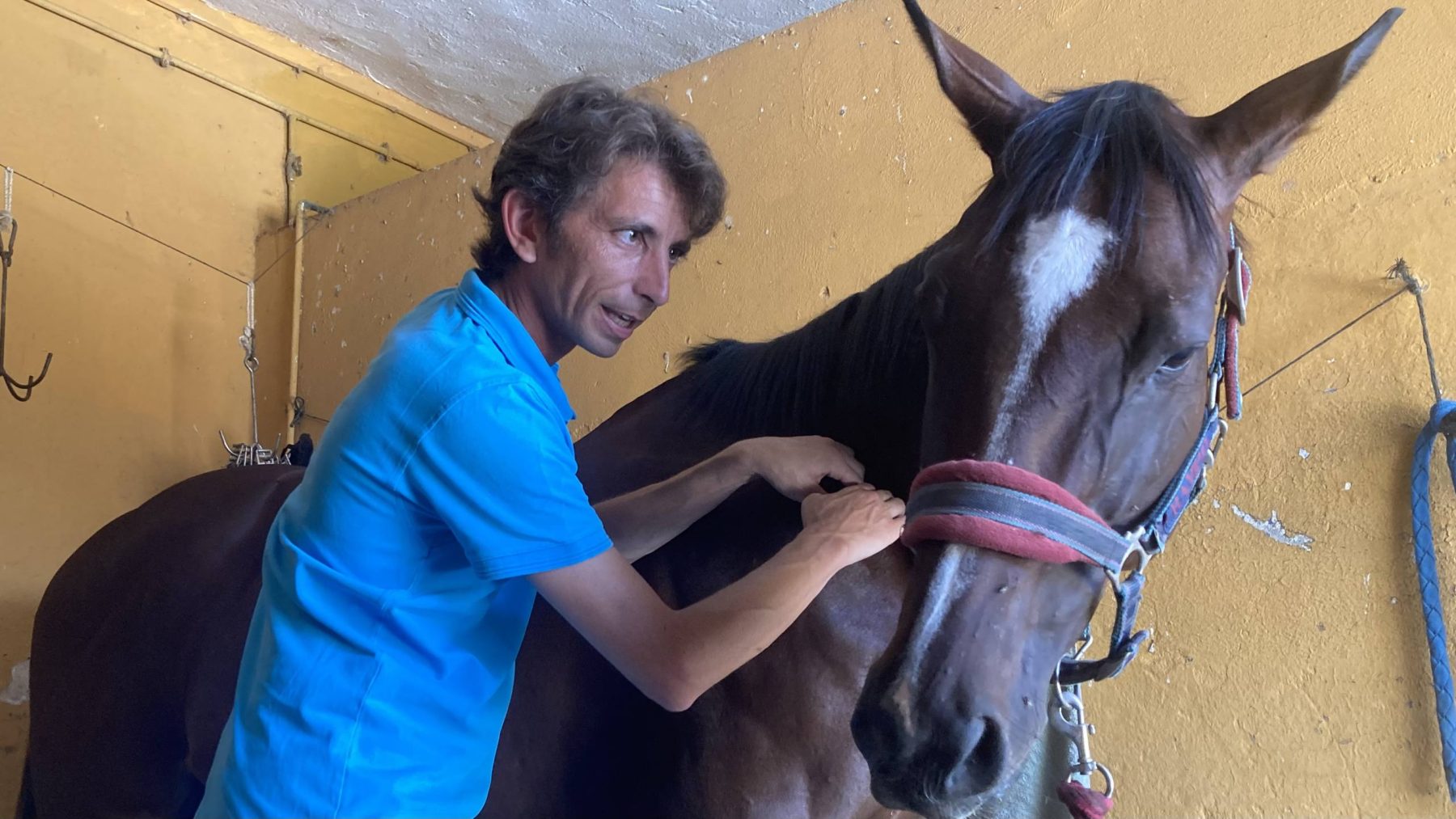
Matthias Agneessens manual therapist and founder of Move2Ride, has this to say on the matter.
“If your shoulders tip forward, so do your seating bones, and you end up loading the front of your horse,¨he says.
Not ideal, as we’re rather seeking to get our horses off the forehand. The position of our shoulders, and with that the pelvis, causes our equine partner additional inconveniences.
“Your pelvis can restrict the horse from going forward, as well as our left and right balance. A horse can’t flex through the rib cage to the left or right if we block it with our shoulder and pelvis,¨ Matthias points out.
We may not realise it is us as a rider, but think it is our horse which has a flexibility issue, and it may well be so. Hence, it is always worth checking horse and rider for imbalances.. However, that it is rather us with the flexibility issue becomes more apparent when we ride multiple horses.
“If we have more than one horse with the same problem – is it us, not the horse?” questions Matthias.
In the case of our horses´ shoulders, for them to move more freely, our equine partners need to lift themselves from their abdomen, Matthias explained.
Rider influence on the TMJ
A human tendency to hold the reins tight without give, instead of pushing the hands forward with the movement of the horse’s head, blocks our equine partner’s jaw, Matthias remarked.
“When I treat horses I often see that the cartilage of the TMJ is completely gone or worn down unequally,¨Matthias reveals.
An unbalanced jaw leads to horses becoming frustrated.
“When they clench their teeth, they feel tension and the nuchal ligament, occiput and atlas-axis will become blocked,¨explains Matthias.
Unfortunately, the TMJ was often overlooked by veterinarians and bodyworkers during their checks, reckoned Matthias.
“After unblocking the TMJ you find a lot of relief as the horses feel a lot of releases in the neck,¨he adds.
And it doesn’t stop at the neck. The TMJ connects via the nerves and muscles in the neck, along the back, all the way to the hind end. A blocked TMJ can express itself as sacroiliac (SI)-joint tension, and reduced hindquarters engagement.
Flexibility for horse and rider
For smooth rides, without pain for both, our equine partner and ourselves, we need to become aware that we need to work as much on our horses, as on ourselves.
¨We spend thousands on our horses, but how many of us spend time to keep our own bodies balanced?” Matthias remarks.
A valid point for sure.
“If your flexibility is off, you’re going to be off in your riding as well.
When you’re crooked on the ground, you’re crooked, on the horse – don’t fool yourself,¨Matthias puts it bluntly, calling for awareness among riders.
“We have to stay aware of our posture and the muscles, and how to use them throughout the day. That makes the difference. We forget unless someone reminds us,” he alerts.
Matthias encourages every rider to consider manual therapy coupled with a balanced training programme for themselves and their horses, and then most importantly, stick to it.
“I’d rather have a healthier rider, than trying to fix things all the time. And only treat, whether horse or human, when it is really necessary. There is no point in automating treatments to let’s say weekly, or monthly,¨ he explains.
Bidirectional effects in biomechanics
So once again we’re asked to look bidirectional in our equine partnerships. The rider affects the horse and the other way round. And it shouldn’t be difficult to feel empathy for our equine partners, as we can have the same blockages and pain issues.
“I see a lot of human SI-joint issues. When they are tight your hamstrings are tight, you can’t contract your lower abdominal core, and it is the same with your horse,¨ Matthias says.
As his colleagues at the conference already expressed, Matthias sees the same bi-directionality when it comes to assessing horses.
“Veterinarians are often taught to only look from the bottom up, not from the top down, biomechanics go both ways,¨he emphasises.
Nothing is perfect, neither horse nor human, one simply cannot, and should not, force things. Indeed, doing less could be more in some instances.
“If a horse is misaligned, my approach is to help them to be as good as they can be. For example, take kissing spine, you can’t get rid off it 100 percent, even with surgery. However, you can teach the horse to use the right muscles to support the spine,¨ Matthias adds.
¨If we ask the horse to use the right muscles to power that horse, then you feel there is a vertical balance. And this leads to injury prevention,¨he concludes.
In the mood to get yourself and your equine partner into balance? You can find Matthias on Move2Ride