
'/%3E%3Cpath%20fill='%23b2b2b2'%20d='M241%20382q0%2016%2017%2026%2017%2011%2042%2011t42-11q16-11%2017-26V269H241'/%3E%3Cpath%20fill='%239f7e00'%20d='M241%20379q0%2014%208%2023%209%209%2021%209%2014%200%2021-9%209-9%209-23V269h-59'/%3E%3Cpath%20d='M241%20339v-70h59v110q0%2014-9%2023l-6%205v-68h-15v72q-8%200-14-4v-68zm59%2040c0%2022%2015%2032%2029%2032%2021%200%2030-18%2030-32v-40h-59'/%3E%3Cpath%20fill='%239f7e00'%20d='M266%20277v5h2v12h-3v-5h2v-5h-9v5h2v5h-4v9h3v18h-5v10h34v-10h-5v-18h3v-9h-4v-5h2v-5h-9v5h2v5h-3v-12h2v-5zm42%20101q0%2010%206%2017%206%206%2015%207%2010-1%2016-7%206-7%206-17v-29h-43'/%3E%3Ccircle%20fill='%230044ad'%20cx='329.5'%20cy='372'%20r='6'/%3E%3Cellipse%20fill='%230044ad'%20cx='300'%20cy='340'%20rx='16'%20ry='21'/%3E%3C/svg%3E)
'/%3E%3C/svg%3E)
Summary
Less drama solutions: How to cross water with a willing partner.
We’ve probably all come across a water-shy horse at some point, resulting in a tedious discussion and futile attempts to explain to said horse that it is ok the water won’t bite you. Our equine friend continues to say no, leading to frustration, urging and pushing, whilst our horse’s feet simply stay stuck.
The solution – Drop the urgency, Understand what they see, Overcome fear together
‘You can lead a horse to water but not force it to drink´ Pretty much the same holds true for ‘you can lead a horse to water but not force it through´
Why are horses reluctant to just walk straight into a puddle?
Horses can’t see the depth of what they are walking into head-on. Don’t forget their eyes are on the side of their heads; they have a very wide angle of viewing, but a blind spot right in front of their nose and behind their tail. That is why allowing your horse to lower their head at things that worry them can change their attitude from fear to curiosity in seconds. They can move their head freely and check, instilling confidence.
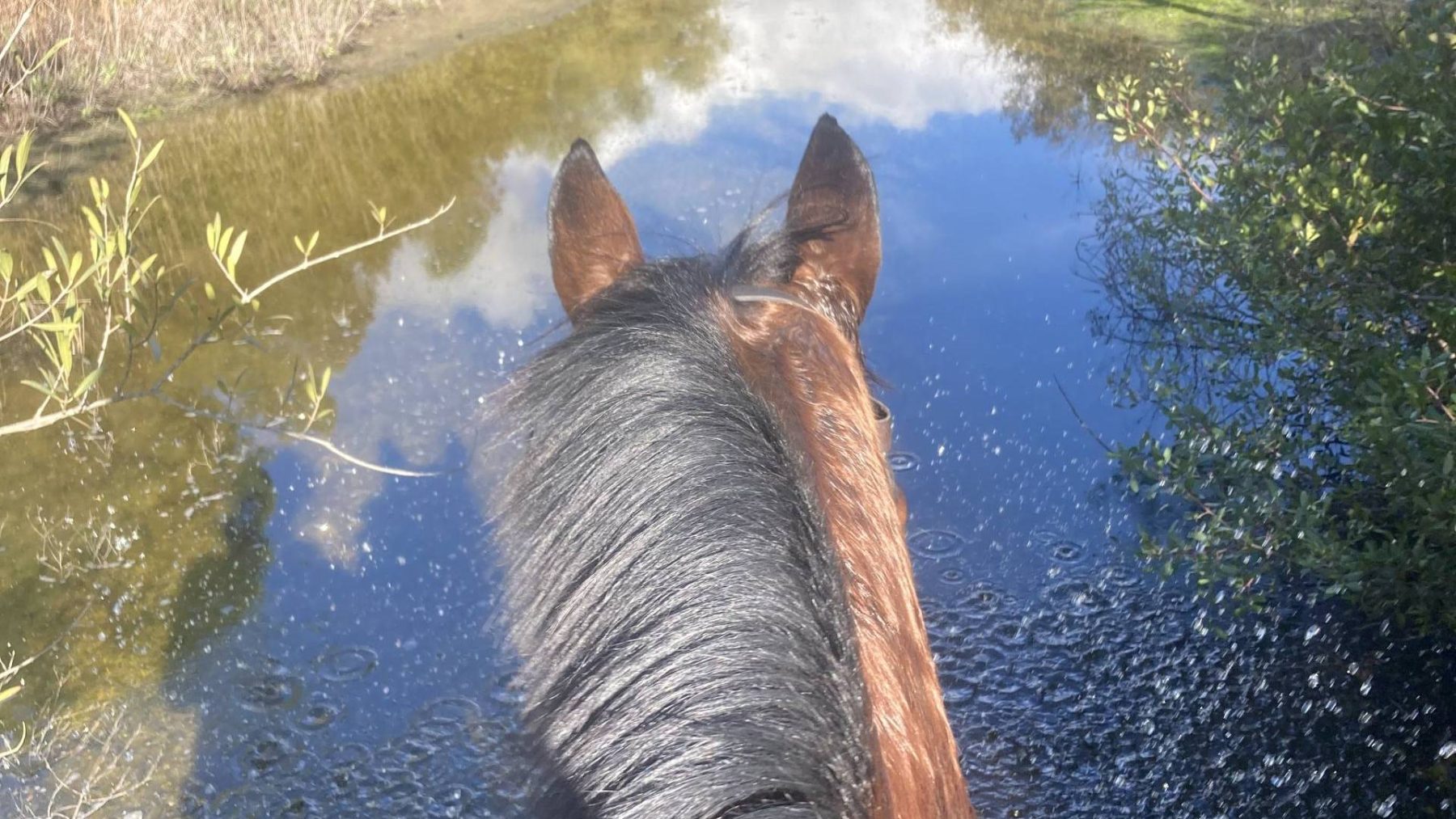
Riding straight towards a body of water falls into this category. Our equine partners can’t see the depth clearly, and they really want to, as their instincts warn them it could be a hole swallowing them alive. The murkier, or the more glistening with reflections, the water is, the harder it is to see depth, plus the confusing images contribute to the fear.
And if we’re honest, we often don’t know how deep it is ourselves. Unless we happened to know said water spot. So would we just step straight into an unknown body of water? Not if we don’t feel like it. So, is it fair to ask our horses to do it? Not really.
And it isn’t that they are just being stubborn when riding, something one hears a lot. Am sure you have seen horses avoiding puddles in their paddocks as well.
It is no wonder, then, especially when we are riding, we are basically asking our equine partner to go first; they baulk at the idea.
The more we push, the more anxious horses generally become. Depending on their character and training, some horses, which have learnt there is no point in fighting, might go forward, but does that really build trust? It’s likely that each new water crossing will cause a dramatic scene until trust is built.
How to go about training for water crossings in a horse-friendly way
If you have the time, invest it in building trust by exposing your horse to similar situations. For example, a tarp can simulate water—practice walking over it. Go first; if your horse trusts you, it will follow. Then, practice lunging over it. First, encourage your horse to approach as fast as he is willing to, let him sniff, and allow him to establish what he’s going to step on—in his view—and sooner or later he will. Praise him, and voilà: confidence and trust gained with patience and no drama.
But let’s say you’re confronted with a puddle or stream whilst riding, and there is no way around it. Encourage your horse to approach, let him sniff the water, and he may even drink. Wait, encourage using your voice, maybe even lean forward so you’re kind of next to his head, and tell him he can do it, you’re there with him.
This may fail if he’s really worried. In the event you do not want to walk through that particular water body yourself, take your equine partner’s approach to, and sniff of, the water as a win and go and find yourself a shallower piece of water you can walk through yourself. Get off and let your horse follow you, praise. Get back on, and now ask him to go first; in most cases, he will have gained the confidence to do so.
Obviously, if someone is riding with you, and the other horse just walks through, yours is more than likely to find the courage to follow, and learn this way that he can do it without dying in the attempt.
Personally, I have come across especially Arabians and French Trotters, who hate water and changes in colour in the sand. A darker sand colour could be a hole, triggering a full stop from a trot or canter. My Arabian did it repeatedly, even if it was the same spot. It didn’t take much more than a second, though, for him to establish that he could continue! Can’t fault him on his survival instincts!
The sea: Waves up the challenge
The best way to get water-shy horses to make friends with what we consider fun, swimming, I found, is based on patience and encouragement.
It took me a few weeks to get my favourite Arabian mare, who was the not-so-confident, dramatic type, to take one step into the ocean. Waves, no matter how gentle, turn into the ultimate sea-monster.
That it was warm helped. I could just sit in the water, keeping her on a long lead rope, encouraging but waiting for her to muster courage.
Curiosity won at some point, she decided ok I trust seeing that you’re still alive and join you. From there, she discovered she loved swimming in the sea, even with high waves breaking over her.
The French Trotters have a similar story. Getting off their backs and showing them first did tons for their confidence.
Whilst my experience with Thoroughbreds, the ones I know at least, is that they have no fear and love swimming.
Bottom line is that if you’re after creating a true partnership based on trust and cooperation, rather than dominance and force, these are just some recipes which work.
Would love to hear your experiences, do share in the comments.