
'/%3E%3Cpath%20fill='%23b2b2b2'%20d='M241%20382q0%2016%2017%2026%2017%2011%2042%2011t42-11q16-11%2017-26V269H241'/%3E%3Cpath%20fill='%239f7e00'%20d='M241%20379q0%2014%208%2023%209%209%2021%209%2014%200%2021-9%209-9%209-23V269h-59'/%3E%3Cpath%20d='M241%20339v-70h59v110q0%2014-9%2023l-6%205v-68h-15v72q-8%200-14-4v-68zm59%2040c0%2022%2015%2032%2029%2032%2021%200%2030-18%2030-32v-40h-59'/%3E%3Cpath%20fill='%239f7e00'%20d='M266%20277v5h2v12h-3v-5h2v-5h-9v5h2v5h-4v9h3v18h-5v10h34v-10h-5v-18h3v-9h-4v-5h2v-5h-9v5h2v5h-3v-12h2v-5zm42%20101q0%2010%206%2017%206%206%2015%207%2010-1%2016-7%206-7%206-17v-29h-43'/%3E%3Ccircle%20fill='%230044ad'%20cx='329.5'%20cy='372'%20r='6'/%3E%3Cellipse%20fill='%230044ad'%20cx='300'%20cy='340'%20rx='16'%20ry='21'/%3E%3C/svg%3E)
'/%3E%3C/svg%3E)
Summary
A guide to electrolytes to ensure the health of your horse during summer.
How to keep your equine partner’s electrolyte intake balanced in the heat.
Summers are a story, of chilling in the pastures, or doing the rounds at competitions, it all depends on where we live. The bottom line though remains, it is hot! And a horse that sweats loses electrolytes, which must be replaced for your equine partner to function from baseline survival to performance.
Yes, there is salt but there is more…
Electrolytes equal mainly sodium and chloride aka salt, potassium, but also magnesium and calcium. And all of those are essential, working together in harmony at the correct amounts to keep your equine friend’s metabolic health, and all are lost in sweat to different extents.
What happens if…
Think of electrolytes as electrically charged minerals busy working behind the scenes to power our horse’s nervous and circulatory system, fluid flows, including gut hydration, muscular functions, and whilst at it balances blood pH.
The inner workings reveal electrolyte ions moving in and out of our horses´ cells pulling water with them, something known as maintaining the perfect osmotic pressure, imagine a microscopic pumping system.
Muscles: Sodium & Magnesium & Calcium
In essence this means a lack of, or imbalance, could lead to stiff (tying up) and/or twitching muscles, as well as the thumps. The veterinary term Synchronous Diaphragmatic Flutter (SDF) explains what happens. In short you’ll detect what seems like a second heartbeat in the flanks, but what are actually the diaphragm muscles repeating the signal due to nerve malfunction.
Which leads to…
Circulation: Sodium & Chloride & Potassium
Blood and cells need water and the perfect pH balance to keep enough volume to move oxygen and nutrients. We’re talking again about the pumping system keeping osmotic pressure at an optimum to keep organs healthy.
Muscles demand the most of your equine’s metabolic system, converting nutrients into the raw energy required to move. During high-intensity work, this rapid energy conversion can alter the delicate fluid and acid-base balance within the muscle tissue.
As your horse sweats during hard work sodium, potassium, and chloride ions jump in to ensure osmotic pressure and regulate cellular pH to prevent this system from crashing. A potential electrolyte shortage would stop the transport of metabolic nutrients and the resulting crash becomes evident in your equine partner suddenly severely tiring.
Digestion: Sodium & Chloride
We usually blame our horses not drinking enough thinking of the dreaded impaction colic, which is certainly true. Remember, sodium creates thirst. In addition, sodium and chloride are responsible for pumping water into the intestines. A lack of salt could therefore result in an impaction colic, even if your horse were to drink enough.
Nerves & Brain: Sodium & Potassium & Calcium
Without electrical currents sending messages to nerve cells to ´talk’ our horses would lose their reflexes, couldn’t think, or do other involuntary bodily functions, such as the heart beating and simply breathing. How would you know? A confused, lethargic and depressed horse may be a clue to what is going on inside.
How much to supplement and when?
You may have noticed sodium appears no matter which bodily function we’re talking about, but don’t grab your pickle and shovel and head to the closest salt mountain just yet.
Consider this first.
Your equine friend’s actual needs, as in climate, activity and diet.
Horses, average 500 kg, at rest require around 28 grams of salt just to survive. Do they find this in their diet?
They will find most of it in their forage, minus Sodium. Chloride also depends on where the hay was grown, or the pasture is located. Only a hay test would reveal. But as Salt is around 40% Sodium and 60% Chloride, the easy bet is to simply supplement with 28 grams salt a day.
In case of horses doing absolutely nothing, and aren’t sweating exorbitantly, a salt block may well suffice. However, check that they are actually using it, as not all horses do. Some don’t like the texture. You could also just put a bucket out with loose salt.
Potassium is found abundantly in forage and grains, and as calcium and magnesium are needed in smaller amounts it usually is also covered by the diet.
However, we are talking about summer.
Chloride is the one to deplete first via sweat, followed by sodium, potassium and to a lesser extent magnesium and calcium. In general it would be safe to assume horses out of work sweating only a small amount are good to go with salt supplementation.
When it comes to training and competition, however, a complete electrolyte supplement becomes a vital ingredient in the diet.
To not overdo the salt in the feed, as some horses will turn their noses up at it, as a note, salt on an empty stomach will burn, I keep up my plain salt dosing in summer in hot weather, leading to some mild sweating, increasing it to 45 grams but fed over three meals a day.
I keep it that way no matter if the horse works that day or not, just to keep the levels up. Kidneys can regulate sodium chloride uptake, and surplus will be peed out.
This does not cover an hour of hard sweating. But on the day of training the horses will get an electrolyte supplement on top of the salt to cover everything lost in the sweat of that particular day immediately.
How much that is depends on how much your horse has worked and how hard he sweated. The below chart can help you to calculate exactly what your equine partner would require.
Light vs. Hard Work (Per Hour)
| Electrolyte Ion | Concentration in Sweat | 1 Hour of Light Work
(5 Liters of Sweat) |
1 Hour of Hard Work
(12 Liters of Sweat) |
| Chloride (Cl⁻) | ~5.3 grams / Liter | 26.5 grams | 63.6 grams |
| Sodium (Na⁺) | ~3.1 grams / Liter | 15.5 grams | 37.2 grams |
| Potassium (K⁺) | ~1.6 grams / Liter | 8.0 grams | 19.2 grams |
| Calcium & Magnesium | ~0.2 grams / Liter | 1.0 gram | 2.4 grams |
| Total Loss | ~10.2 grams / Liter | 51.0 grams | 122.4 grams |
A tip on commercial electrolytes. Read the label carefully. It should list sodium chloride as the first ingredient and then potassium and calcium and magnesium, as well as the amount. Some brands put dextrose first claiming it assists absorption. It does not and could create more harm than good.
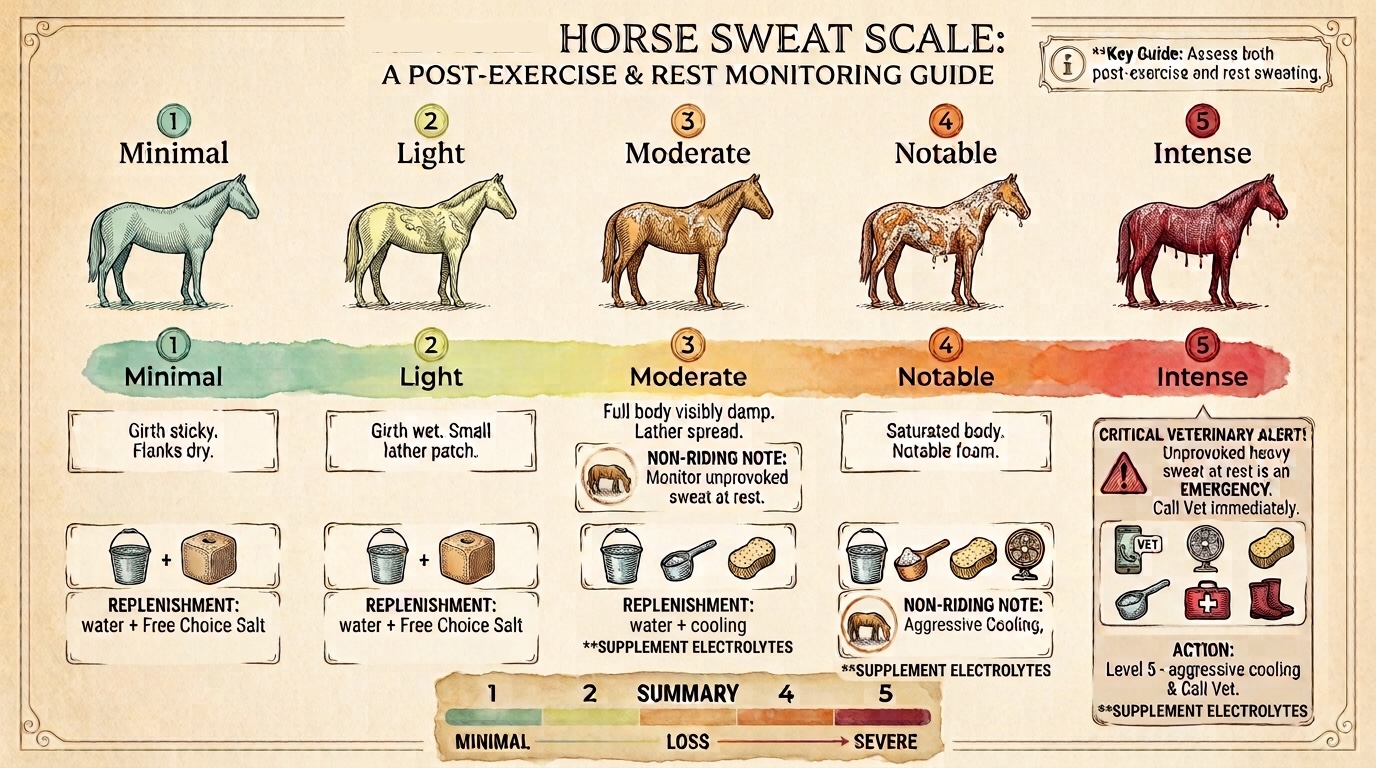
And here an illustration to give you an idea of the levels of sweating.
-
- Sweat Scale
Some dehydration signs to watch out for:
Excessive salt-seeking, such as licking metal objects, eating dirt, or eagerly licking sweat off your skin could indicate a natural drive to replenish lost salt.
Droppings lose moisture and look noticeably harder or drier than normal.
Keep an eye on urine colour: Clear: Optimal hydration. Light Yellow: Acceptable. Dark Yellow: Dehydrating Rusty Tint: Dehydrated a saline drip would help to remediate fast. If you’re unsure how to handle call the vet!
Whatever you do, do not force oral electrolytes if your horse refuses to drink, as concentrated salts will draw remaining fluid from tissues and worsen dehydration.
You can also check dehydration by pinching the skin on the neck, which should bounce back fairly fast. It isn’t the most reliable test, though, as it depends on individual skin elasticity. A mucous membrane test is more accurate, your finger should slide easily over your equine’s gums, a sticky or dry feel signals dehydration. Complete the test by briefly pressing a finger or thumb into the gum. The gum will turn white and once you let go, blood should refill quickly within 1-2 seconds. A capillary refill time over three seconds means your horse is dehydrated.
Happy summer everyone!