
'/%3E%3Cpath%20fill='%23b2b2b2'%20d='M241%20382q0%2016%2017%2026%2017%2011%2042%2011t42-11q16-11%2017-26V269H241'/%3E%3Cpath%20fill='%239f7e00'%20d='M241%20379q0%2014%208%2023%209%209%2021%209%2014%200%2021-9%209-9%209-23V269h-59'/%3E%3Cpath%20d='M241%20339v-70h59v110q0%2014-9%2023l-6%205v-68h-15v72q-8%200-14-4v-68zm59%2040c0%2022%2015%2032%2029%2032%2021%200%2030-18%2030-32v-40h-59'/%3E%3Cpath%20fill='%239f7e00'%20d='M266%20277v5h2v12h-3v-5h2v-5h-9v5h2v5h-4v9h3v18h-5v10h34v-10h-5v-18h3v-9h-4v-5h2v-5h-9v5h2v5h-3v-12h2v-5zm42%20101q0%2010%206%2017%206%206%2015%207%2010-1%2016-7%206-7%206-17v-29h-43'/%3E%3Ccircle%20fill='%230044ad'%20cx='329.5'%20cy='372'%20r='6'/%3E%3Cellipse%20fill='%230044ad'%20cx='300'%20cy='340'%20rx='16'%20ry='21'/%3E%3C/svg%3E)
'/%3E%3C/svg%3E)
Summary
Here is a look at all the factors to decide whether it is safe to ride or take a rain – well, sun – check in this instance.
I don’t know about you, but when the summer hits I tend to be glued to the weather forecast planning my training, and changing length, intensity and timing ad-hoc usually before the sun rises, and again late afternoon.
It really depends where one lives but in hotter climes checking temperature, humidity, wind speed becomes rather addictive.
As a leisure rider I would just give the summer off, and/or dedicate it to light groundwork playing around, hanging out and maybe a light bareback hack. But for those of us who have to keep horses in training because of upcoming competitions, it is simply a matter of meticulous management.
Sweating in itself is not evil, on the contrary, whilst a fit horse may sweat less, a horse, which doesn’t sweat at all when it clearly should is not a sign of fitness but a warning sign. Anhidrosis is a condition where the equine sweat system fails, and as it is the only way for your equine partner to cool down carries the danger of a heat stroke. So do keep your eye on that one.
So, can it be too hot to ride?
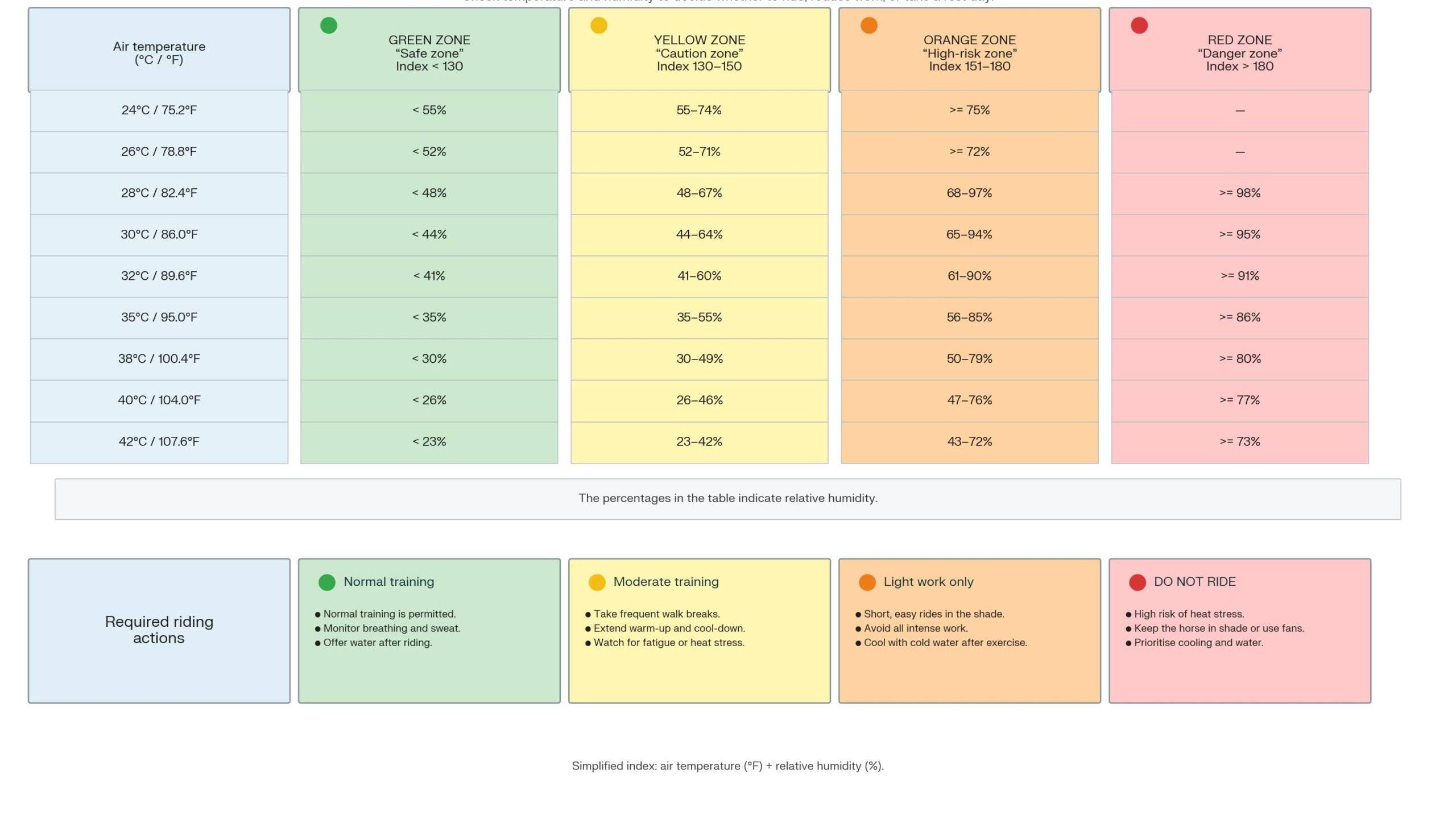
It definitely can, as you can deduce from the infographic introducing this article. I never found one in centigrade Celsius but rather in Fahrenheit, so I did the calculations for all of us to have a quicker overview, no matter where we live.
There is a lot of truth to this method, as if it is hot and dry you’re better off than when it is hot and humid, in the latter it’s harder for your horse to cool down.
There are some other factors to take into account though:
The wind:
A hot one obviously doesn’t help much, a cooler wind definitely helps your horse and so does speed. At the same time make sure the wind doesn’t disguise reality, as sweat will dry faster than you notice. However, it does usually leave a sticky or salty marks on your horse hinting to the sweat status.
So it may look like you’re heading out at the limit of the danger zone, yet the wind rescues your ride, as the your horse, and probably yourself, dripping in sweat are cooled down by the breeze. Be ready to abort though if you feel your equine partner is simply breathing too heavy. It is easier to do when you’re in the arena right next to the showers.
But if you’re an endurance rider, don’t stray too far. You still have to head back!
This brings me to the other major factor: Cold water availability!
As we said equine’s only way of cooling their core temperature is sweating. The ambient air dries the sweat cooling the horse, which sweats more and on it goes. Now when that ambient air is actually humidity that evaporative system doesn’t work so well and the horse struggles to cool down.
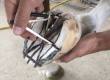
The most efficient way to help the cooling process is to wash the hot sweat off with as cold water as possible until the core temperature has dropped. This means continuous pouring of water, no scraping, over the whole body and targeting the large veins, such as the jugular and inner leg veins, as well as behind the ears, in particular helps speed up cooling. Simply because these veins run close to the surface.
Take your equine’s heart rate, which will indicate recovery.
Why am I mentioning the cooling technique in the first place? If you’re judging whether it is too hot to ride, consider if you can implement this cooling process as you get back to the stable. If you don’t have cold water available, or just any water in large buckets filled with ice, it is too risky to let your horse get too hot during your ride, and your best bet is to just let him relax. This counts for arena rides as well.
The possibility of water somehow coming with you on an outride also changes the equation. It could be a car transporting cold water bottles, streams or lakes, they all help to change the risk to a calculated extent. That includes water for them to drink and pour over their bodies.
A myth buster:
Whilst we’re on the subject of drinking water. A hot horse drinking cold water does not provoke a colic. Equine research studies prove it doesn’t. And from practical experience, I haven’t seen any endurance horses coming from the track immediately choosing to drink ice water even, coming down with a colic.
The bottom line being the wellbeing of our equine partners comes first. If it is too hot to ride, it simply is too hot to ride.
Enjoy just relaxing with your equine partner, there’s always another day to pick up training!