
'/%3E%3Cpath%20fill='%23b2b2b2'%20d='M241%20382q0%2016%2017%2026%2017%2011%2042%2011t42-11q16-11%2017-26V269H241'/%3E%3Cpath%20fill='%239f7e00'%20d='M241%20379q0%2014%208%2023%209%209%2021%209%2014%200%2021-9%209-9%209-23V269h-59'/%3E%3Cpath%20d='M241%20339v-70h59v110q0%2014-9%2023l-6%205v-68h-15v72q-8%200-14-4v-68zm59%2040c0%2022%2015%2032%2029%2032%2021%200%2030-18%2030-32v-40h-59'/%3E%3Cpath%20fill='%239f7e00'%20d='M266%20277v5h2v12h-3v-5h2v-5h-9v5h2v5h-4v9h3v18h-5v10h34v-10h-5v-18h3v-9h-4v-5h2v-5h-9v5h2v5h-3v-12h2v-5zm42%20101q0%2010%206%2017%206%206%2015%207%2010-1%2016-7%206-7%206-17v-29h-43'/%3E%3Ccircle%20fill='%230044ad'%20cx='329.5'%20cy='372'%20r='6'/%3E%3Cellipse%20fill='%230044ad'%20cx='300'%20cy='340'%20rx='16'%20ry='21'/%3E%3C/svg%3E)
'/%3E%3C/svg%3E)
Summary
When science meets practice. Farriers need to have an in-depth understanding of equine body function to be effective at their jobs.
Also presenting at Move2Ride´s Equine Edge conference, Yogi Sharp aka The Equine Documentalist, as a farrier on a mission to improve hoof health, talked in tune with Sue Dyson, advocating keeping horses outside boxes, in the case of space constraints track systems could do the trick.
He bridges ongoing scientific research with practical application. But let’s not get too technical here.
You can find out more about his work on his Equine Documentalist platform, where the likes of veterinarians, farriers, bodyworkers, and equine scientists come together to share knowledge to enhance equine welfare globally.
Yogi equally believes turnout creates healthier horses. Body proprioception is a fundamental function to take into account when going about assessing hooves.
“We can’t deal with the horse compartmentalised, then you go around in circles. You have to address the bidirectional relationship and work as a team – body and hoof – taking into account the organisational costs of the whole proprioceptive nervous system,” he emphasises.
What does he mean by bidirectional?
In short, our horse’s hooves feel the ground and send signals on what to do to the musculoskeletal system via the nervous system. Equally, signals get sent from the top down.
The farriers job is to create the ideal base for this proprioceptive play to work, whilst body workers and vets ensure feet are optimally loaded from above, he explained, adding that equine postures can be addressed but within the limits of its natural conformation.
“Farriery can affect the hoof angle but even if you adjust the medial-lateral balance chasing level landing, horses still choose to land the way they want. Level landing has no correlation to loading; that is when injury is going to occur,” he points out in terms of trying to correct equine movement through trimming.
Yogi is basically explaining that farriers cannot influence the full cycle of a horse’s foot flight, pointing out that the landing impact stance only represents 5% of the total flight. Hence, watching a horse merely walk before shoeing is not sufficient to establish what needs to be done.
“Most soft tissues are injured at mid-stance when the whole body weight is on the leg preparing for the break-over phase, so our job as a farriers is to keep the system working at mid-stance,” he emphasises.
The solution in Yogi’s toolkit is to take a close look at the horse’s posture when it is standing, let it walk, and then trot when its gate becomes more symmetrical and take a close look at the hoof capsule.
Achieving balance all round
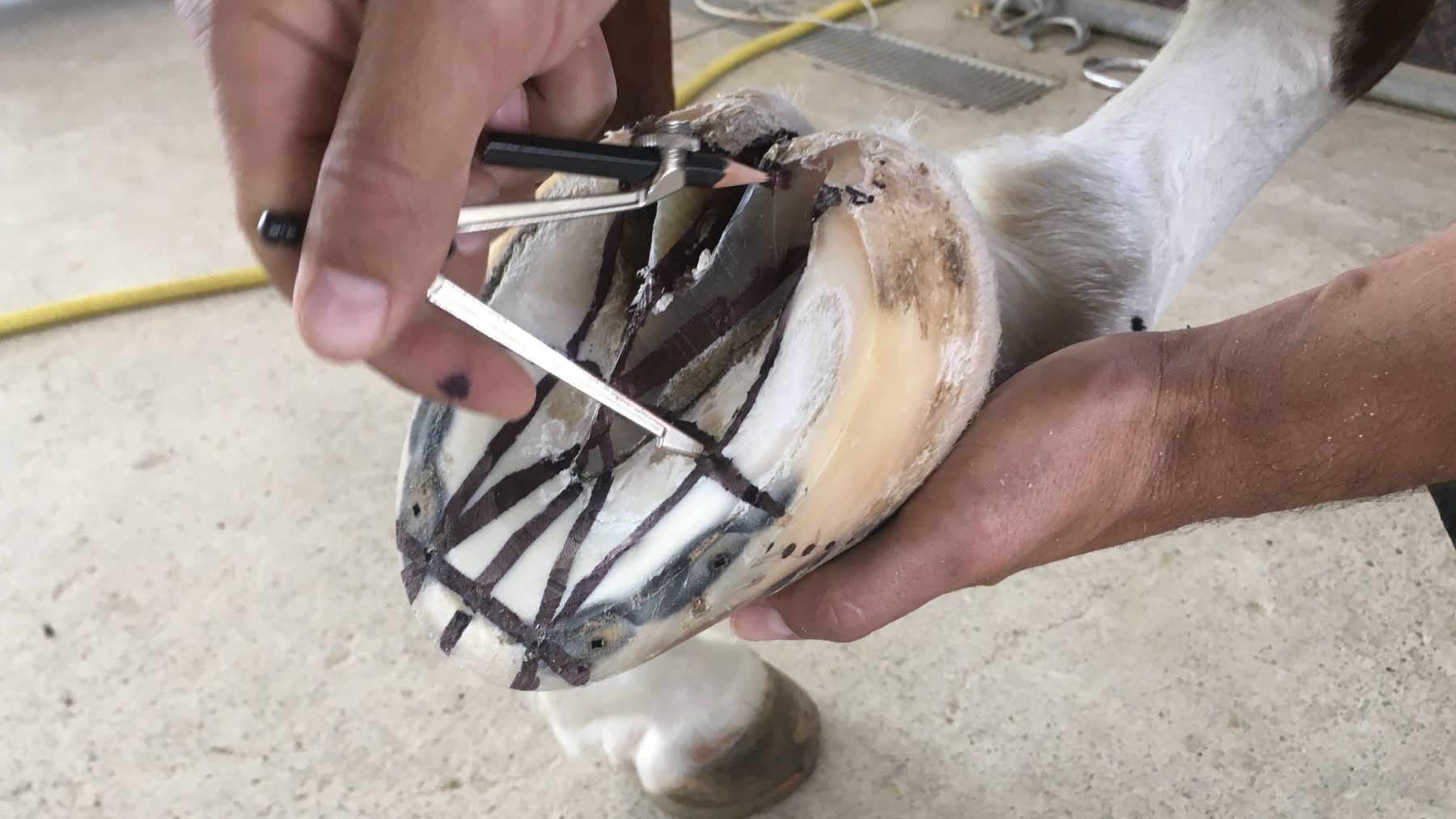
Ratios, and taking into account the natural disposition of a horse’s hoof capsule and body conformation, are paramount to getting the medial-lateral and dorso-palmar balance right. That is in-to-out and back-to-front of the hooves.
Yogi advises his colleagues to integrate false flexions in cases of medial-lateral imbalances to take the pressure off horses, who don’t want to land level.
This is a concept promoted by the F-Balance method. It basically means leaving a gap on the side where the hoof capsule demonstrates upward pressure, look at the hairline, when trimming that side. As the hoof capsule is elastic, when the horse puts weight on that hoof, it actually levels down to the ground.
The dorso-palmar balance tells a similar story.
“A long toe to low heel ratio, most horses have that. Foot heel failure is actually a factor of a horse exceeding its elastic capability due to lack of function,” Yogi explains.
“Then we come and stick on something super stiff and wonder why the hoof exceeds its elastic capacity. Barefoot, the horse can absorb shock by expanding and contracting its heels. The more we restrict, the worse it is, such as using bar shoes for long toe and low heel cases,” he adds.
This does not mean that horses have to be barefoot or else. It is rather a matter of restoring functionality using correct ratios for that specific horse, not generalised ones.
“The problem with the hoof capsule is that in farriery we think in two dimensions, when we have to consider the three dimensional balance,” alerts Yogi. To facilitate our brains doing so, he has created an app called HoofmApp.