

'/%3E%3Cpath%20fill='%23b2b2b2'%20d='M241%20382q0%2016%2017%2026%2017%2011%2042%2011t42-11q16-11%2017-26V269H241'/%3E%3Cpath%20fill='%239f7e00'%20d='M241%20379q0%2014%208%2023%209%209%2021%209%2014%200%2021-9%209-9%209-23V269h-59'/%3E%3Cpath%20d='M241%20339v-70h59v110q0%2014-9%2023l-6%205v-68h-15v72q-8%200-14-4v-68zm59%2040c0%2022%2015%2032%2029%2032%2021%200%2030-18%2030-32v-40h-59'/%3E%3Cpath%20fill='%239f7e00'%20d='M266%20277v5h2v12h-3v-5h2v-5h-9v5h2v5h-4v9h3v18h-5v10h34v-10h-5v-18h3v-9h-4v-5h2v-5h-9v5h2v5h-3v-12h2v-5zm42%20101q0%2010%206%2017%206%206%2015%207%2010-1%2016-7%206-7%206-17v-29h-43'/%3E%3Ccircle%20fill='%230044ad'%20cx='329.5'%20cy='372'%20r='6'/%3E%3Cellipse%20fill='%230044ad'%20cx='300'%20cy='340'%20rx='16'%20ry='21'/%3E%3C/svg%3E)
'/%3E%3C/svg%3E)
Summary
The lowdown on fencing materials, shapes and heights.
Oh, oh.. that sight of an empty paddock, or, hang on, didn’t I release five horses into the field this morning? I count four; where is the fifth!? I do spot something chestnut in the distance…how on earth did he get out?
The detective work and catching the mischievous pony is kind of fun when the horsey adventure ends injury-free and no fencing is harmed in the process.
However, depending on the surroundings and circumstances, things can turn ugly very quickly. And there’s something else to consider, horse is where he is supposed to be, but do I spot a splint or wound, uff!
So here are some tips on fencing to keep our equine Houdinis as safe as is humanly possible. I know it’s a bit like taking a swing for the fences 😉
Fencing Materials
Whichever material we choose, whether due to availability or pricing, let’s make sure planks and posts have a certain give, or bounce back, to them. Why?
Horses seem to have a knack for getting injured by kicking and rolling near fences. Skin and bones meeting unforgiving surfaces equals cuts and bone splints. The former are usually just scrapes; the latter, depending on the location, could be performance-ending.
Iron and/or metal fencing can be far too hard for our sensitive equine legs.
Having said that, should it be the only material at your disposal, there is a way to reduce the menace, via the design.
Design
Shapes and spacing are important in equine fencing!
Unless you have a professional installing a steel fence using flex-mounting, only choose thinner metal, as in diameter, and above all ROUND rails, never PLANK-type metal. This will make this type of fencing more forgiving.
Additionally, make sure you maintain the fence, regularly checking for rust. Because, metal pipes that snap are known to have cut the arteries of horses, an event from which there sadly is no coming back.
Don’t forget to design your spacing with equine behaviour in mind. Since it isn’t a too rare occurrence that horses rolling near fences get stuck! Although those with a calmer disposition are happy to wait patiently until someone sees them and helps to set them free, many others panic. Hence, the possibility of breaking a leg is an unfortunate reality.
Therefore, make sure the lowest line of the fence is high enough to allow that extra space for horse leg manoeuvres. The next line of rails should make it easy for your equine friend to pop its head through and pull back without banging its head. Alternatively, leave a tight enough space so it can’t put the head through in the first place. The latter option, though, may not be entirely practical in terms of economics, requiring more materials. Obviously, the top rail needs to be high enough for the horse not to feel it can just jump it.
Back to our materials:
Wood
Can be a great option, as it has a certain give yet is strong enough to resist horses pushing on the fence. Albeit maybe not its teeth 😉 These types of fences do have to be checked for splintering and rot in more humid climates. I personally prefer round to plank-type wood, but both work for this type of material.
In either case, choose the type of wood wisely, not too hard, not too soft. As an anecdote, we once used wood from palm trees, as it was the only one available. I saw a Thoroughbred turn into a hamster; within weeks, the poles were reduced to dust, ha, ha!
PVC
Vinyl rails are brilliant in terms of the bounce back mentioned before. They don’t splinter like wood; however, that doesn’t mean they can’t, if not easily, break. They are also nice and smooth, and that won’t change over time. Extreme temperatures, though, can make them brittle.
Wire
This is a tricky one, much depending on the design and type of wire. In the case of tensed galvanised wire, which is attached to wooden posts it is a safe option.
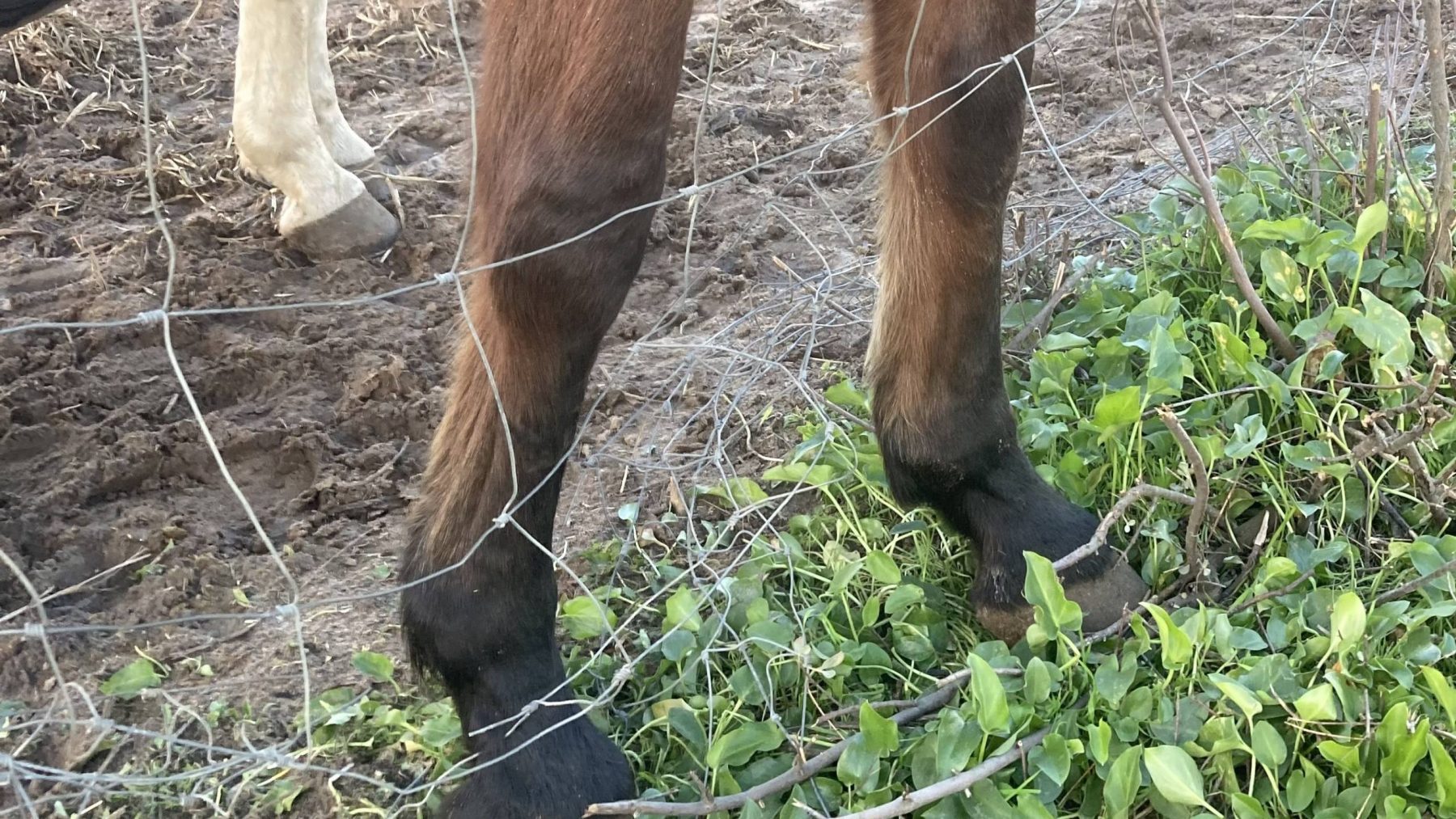
Contrary to loose wire, barbed wire, and stock fencing (those wire fences made out of squares), which to me are potential death traps. Barbed for the obvious reason—it cuts, but so does loose wire once a horse gets entangled in it. And those squares are just begging for hooves and legs to get stuck. (see photo above, this mare is an angel of patience and spotted quickly, so in this case no harm was done. However, I was imagining this happening in the middle of the night, for example…)
Besides, these types of fences are at the opposite end of the spectrum, far too much give.
Electric Tape
Easy to install and cost-effective but comes with a caveat – the need for respectful horses, most would be but some couldn’t care less about a little shock. In any case, I’m not sure I would use it as a main boundary, and definitely not in areas where, if horses break out, they could quickly get themselves into trouble. The reason being, the power can turn itself off without us even being aware it did! Once horses figure out the zap is gone, their respect for the fence turns off at equal speed as the power.
One last note: whichever material you choose for rails and posts, regularly check for sharp edges and screws to avoid cuts and eyes getting poked out.
Happy Fencing!