



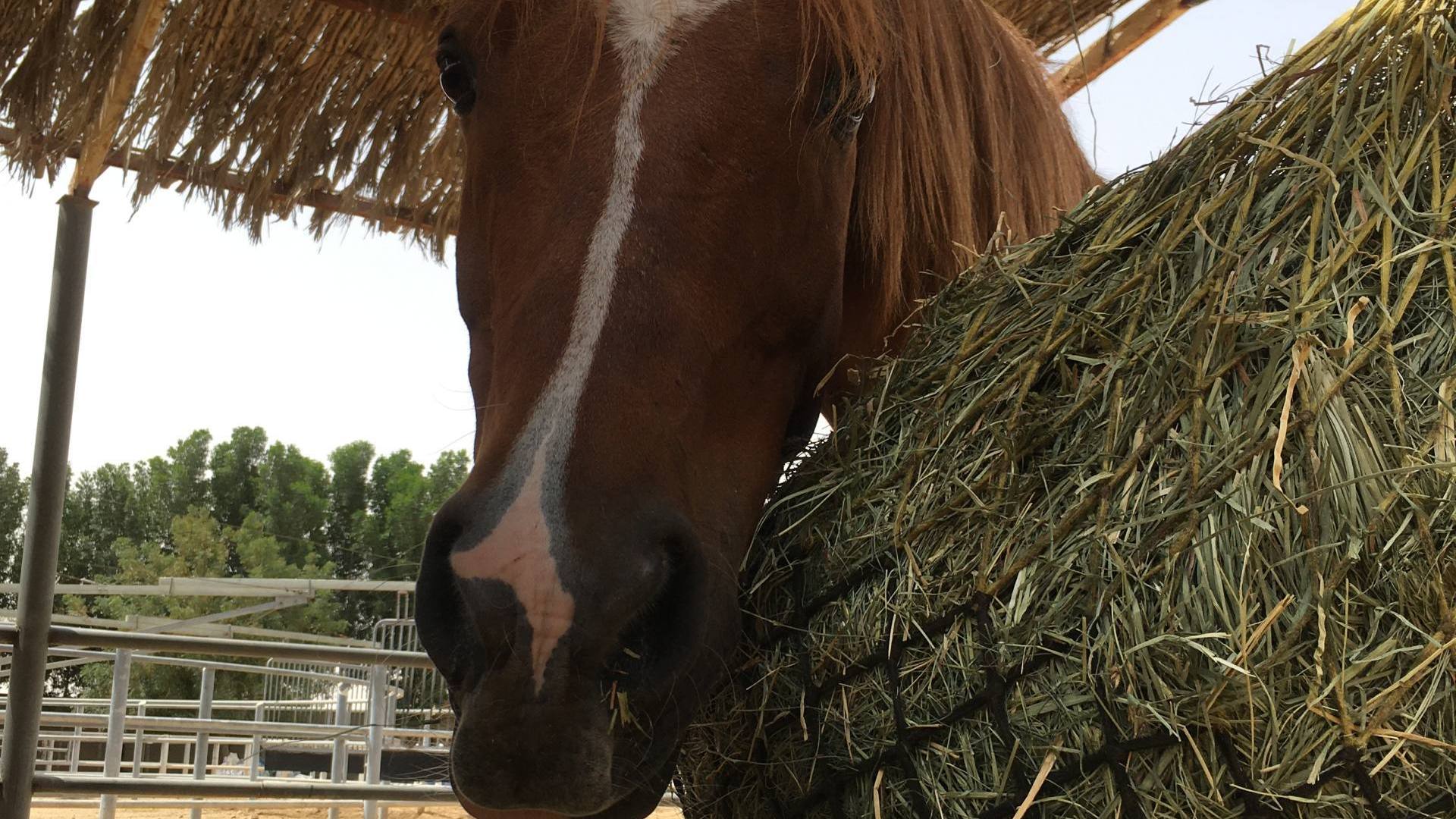
.Is 24/7 hay really a necessity?
There isn’t a horse on this planet, which would say no to the freedom to nibble whenever its stomach tickles. The equine physiology rather demands it. Your horse’s stomach produces acid to digest fibre non-stop, whether it is incoming, or not. It simply expects it to.
Because, when it doesn’t the tickling can quickly turn into burning holes into your equine friend’s stomach, resulting in ulcers. Ouch!
As we know horses can’t reach for their anti-acid tablets on their bedside table, but suffer in silence until it gets too much resulting in those behavioural and performance issues we are so well aware of. A horse that is girthy, or maybe doesn’t want to work, is trying to say, hey it hurts!
Just a follow on note on anti-acid ulcer medicine, such as omeprazole, though. Keep in mind it is a temporary solution to heal ulcers, block the acid, block the digestion of nutrients. We’ll discuss omeprazole and other options in another article.
The above implies that 24 hour access to hay, or pasture, is imperative. However, we know this isn’t always practical.
Horses with metabolic syndromes
For one, we have horses who due to metabolical issues have to be limited from snacking on unlimited rich greens. This doesn’t call for leaving their tummies empty though. Slow feeding hay nets can stretch their hay portions, as well as adding less nutrient rich fibres to their diets to keep that acid occupied.
Eating habits, energy and time constraints
More applicable to sport horses, than leisure, some equines simply can’t deal with unlimited hay supply gobbling down more than their energy needs, leading to at the least undesired hay bellies and at the worst the metabolic issues mentioned above.
Why does this happen? In theory horses shouldn’t want to eat more than 3% of their bodyweight aka feeling full. And some do suggest that when horses get used having unlimited hay supply they only eat as much as they need, some do, but others simply don’t.
A reasonable explanation could be, that one that if they have been rationed before they are anxious to gobble down what is in front of them. Secondly, that equines are made to nibble 24/7 but in nature it would be sparse grasses, not the richer hay we offer our horses. Pasture is another story.
So, we do have to ration. The rule of thumb is a horse needs minimum 1% of its bodyweight in fibre for its system to tick over. Note minimum, 1.5% – 2% would be a good figure to base oneself on. Taking into account other feeds on the menu.
In regard of percentages and body weight. Hay like any other feed should be weighed not fed by volume. It may look like a lot but depending on the type it could be half than what you think!
Hay feeding schedules
This brings us to time.
Whilst it often is, time should never be an excuse not to feed our equine partners as their nature demands. Nights are what we struggle most with. There understandably are few, which would be prepared to get up in the middle of the night to refill hay nets, or boxes.
So, if we’re lucky enough to be able to leave our hose alone with a whole hay bale in his paddock, problem solved. But if not we do have a window of relief.
As, scientifically speaking, an equine stomach can deal with up to four hours between fibre meals, before the acid goes into burning mode.
The solution therefore could be to give the bigger portion of the daily hay ration in the evening, and sticking it into a slow feeding device, hay, or box. You simply have to know how fast your equine friend is in eating his hay, it is very individual.
Indeed, I’ve known horses, who can eat 1kg of hay in 30 minutes, whilst others take two hours.
So, if they are difficult to slow down and the hay you feed is rich, try and source some with a lower nutrient value to up the eating time. Or, get a type of hay, which you know is not your horses favourite, and get them to nibble, instead of gorge, this way.
A hay feeding schedule example
Let’s say you feed hay 5 times a day. An average 500 kg horse requires 10 kg of hay a day.
Feed as early in the morning as possible, let’s say 6 am the first kg before ‘breakfast’ (hard feed).
By the way, it is always better for the horse to have some fibre in his tummy before eating less digestible grains etc., for them not to end up in the hind-gut so quickly and causing hind-gut acidosis (not detectable in an ulcer examination).
TIP: Should you ride before breakfast consider half kg of alfalfa (Lucerne) half an hour before getting ready to ride, a brilliant stomach acid buffer, of what may have accumulated over night.
Then the second lot of hay 2 kg should be served mid-morning let’s say 9 am. Another 2 kg served just before ‘lunch´ around 1 pm that would be half the days hay ration gone. Around 5 pm another 2 kg should be served and the remaining 3 kg at the earliest 8 pm for the night. That would be 10 hours assuming with a slow feed hay net the horse needs 6 hours to eat the hay, and yes, they do sleep at night as well.
In the case, you only have time to feed hay three times daily, break it down into 3 kg morning, 3 kg lunch and 4 kg evening.
Let’s talk floor, boxes, nets…
As mentioned before, horses will eat loose hay a lot faster. Throwing hay on the floor has the added disadvantage of waste, tread, peed and pooped on. Throwing hay in a box is a better option, especially in sandy paddocks.
Important: Sand accumulates in the digestive system and can lead to impaction colic. Consider feeding psyllium once a month to aid expulsion.
And another note on hay feeders, those high ones. To be avoided horses respiratory system and necks are better off eating as nature intended head down. Equally, don’t hang hay nets too high, but neither too low if the horse wears shoes. You don’t want them to get to get stuck in them. Level with the head is safer in this respect.
Now, an open box also invites waste, as horses will look for the best pieces and throw the rest out on the floor before considering them. And then it may have become completely unappetising. Yes, it is worth it to invest, or build your own, hay box with a cover. A frame with a net with holes that moves down as the horse eats.
Otherwise we have hay nets
There have been discussions on whether hay nets cause uneven teeth wear, erring on the side that mostly they do not. However, try not to go cheap. Plastic nets, which break easily may well become a culprit. These days you can order very nice nets made of natural durable fibre. And you can even choose the perfect hole size for your horse to eat slowly, yet comfortably.
As an anecdote for those who worry about their horse at first looking frustrated when presented with a net with small holes. They tend to figure it out pretty quickly, a week at the most. I’ve seen horses after the experience presented with the option of a large hole net versus a small hole net, and they preferred the small holes 😉
Again it is all individual, you can help your horse at the beginning offering both.
I’ll post some links to net producers in the horsey stuff section.
Happy feeding and munching!